August 25, 2011

Avian First Aid Kit: Why Not Make Your Own?

There are so many things that can happen to your bird in our day to day existence and being prepared can save your bird(s) life. Every seasoned or new bird owner should have an avian first aid kit available at all times for emergency care of your bird(s). There are many kits that you can buy online--just do a Google search on the term avian first aid kit, and you'll get lots of results.

What if you don't want to spend your hard-earned money on buying an avian first aid kit that is offered online? Why not make your own? It is not that difficult. Some items you may already have in your home to add to a basic kit.

First of all put together a list (perhaps on an index card) of emergency contacts and keep it with your kit. Your list or card could include your vet's emergency number, a complete medical history of each of your birds including their ages, and the number of a local poison control hotline (in case your bird ingests something harmful), Another thing to consider is adding the phone number of a friend who is also a pet bird owner or someone you trust.

Secondly, you will need something to house your kit items. If you decide to make your own, you can use anything from a 1 gal. ziploc freezer bag to a small tool box, a document case, a small tackle box or an art supply storage organizer. It's up to you. Whatever you have around that would hold the contents you purchase.

Here are things that I recommend you add to your kit, most of which you can find locally. The links are to examples I found online, but other brands will do:


This is by no means an extensive first aid kit to cover all emergencies, but will get you started for minor emergencies until you are able to take your bird to your vet for emergency care. Other items to keep on hand for emergencies are a travel carrier for transportation to a vet. I found a small animal carrier at a garage sale for $2. I cleaned and sterilized it, and it works great. The next is a towel to restrain or secure your sick or injured bird.

Keep your emergency kit near your bird room so that you can get to it immediately.

March 16, 2011

The Grey Cheek: Larger Than Life

Looking for a bird that is affectionate, playful, bold, perky, garrulous, intelligent, inquisitive, fearless, mischievous, feisty, and who thinks that it is as large as a macaw all rolled up in an eight inch long frame? Then look no further, the grey-cheeked parakeet is all of those things and more.
 
Physical Characteristics

(Troll & Radar - photo by Sonja)
Weighing in at 50-65 grams, the grey cheek (Brotogeris pyrrhopterus), also known as a pocket parrot, orange-flanked parakeet or orange-winged parakeet, received its name primarily from its distinctive grey cheeks. Its other distinguishing features are a dusky blue crown, brilliant orange feathers on the underwing, iridescent green feathers on its back, outer wing and tail areas, and a lighter, lime-green shade on its belly. Until 6 months of age, grey cheeks have black or spotty, black beaks and are often not as brightly colored as their parents. As they mature, their beaks become horn-colored (Harris). Grey cheeks are not sexually dimorphic and need DNA testing to determine their sex. According to David Alderton ("You and Your Pet Bird," 1992), the average life span of the grey cheek is 15 years, but some grey cheek owners claim they can live well into their 20s if properly cared for, fed a nutritional, balanced diet, and kept out of mischief.


History/Natural Habitat

According to many sources, the grey cheek was imported into the U.S. in large numbers in the 1970s through the fall of 1992 when importation was halted by a federal bill. Susan Hoss' article, "Hooked on Grey Cheeks," states that grey cheeks were bred by A.R. Hood as early as 1935. Robbie Harris, a California bird breeder and author, is the mostly widely written grey cheek breeder to date with a book (1985) and numerous articles on the grey cheek and the Brotogeris family.


In western Ecuador and northwestern Peru, grey cheeks live in arid scrub lands and deciduous forests, making their nests in old, arboreal, termite nests, decaying wood, or in moss nests in hollow, scrub trees. Their diet consists of petals and seeds of Erythrina trees and the flowers, fruit, and seeds of other native plants (Best, et al.). They also relish the occasional visit to local banana plantations (Worth).

Baby grey cheeks were taken from their nests and hand-fed before leaving their native countries. As a result, they were "tame and sweet" upon arrival in the U.S. or shortly thereafter if the hand feeding or weaning was completed at the quarantine station (Harris and Worth). Because they were so popular and plentiful when they were being imported, Harris mentioned that they sold for as little as $25 - $30. In addition, Harris' prediction of soaring prices is now a reality; they currently range in price from $175 - $400.

Grey cheeks are "near threatened"* in the wild (Collar, et al.), and although they are fairly plentiful within their restricted range in Ecuador, they are now extremely scarce in Peru. Some of the threats to grey cheeks are loss of habitat, local trade, and formerly, the international trade, when they were imported into the U.S. by the thousands, seriously depleting the wild population (Best, et al.). This species is considered the most endangered of the Brotogeris family (Best, et al.). Luckily, four areas inhabited by grey cheeks are protected reserves or national forests, though more areas that they inhabit will need protective status if the grey cheek is going to survive in the wild.

Potential as Pets

It is very difficult to class the grey cheek into any one category, since each bird has its own personality/individuality. Hand-fed grey cheeks are generally affectionate, friendly, have gentle dispositions, and love spending most of their time with their human buddies, forming very strong bonds with their owners. They often beg you for attention and love having their heads and neck scratched, burrowing in your clothes-especially pockets, and will often sleep on their owners. Grey cheeks can be one-person birds or can form attachments to others as well depending on how well socialized they are, the individual bird's personality, and how much time is spent working with them. Grey cheeks are extremely loyal to their owners and are "social" birds that like to be included in household activities as much as possible - especially meals. If in doubt, try taking one to the dinner table with you and watch the little guy dive into your plate, head first!

The intelligence of these birds constantly amazes me. They will figure out ways to get what they want or get to where they want to go by the most outrageous means. For instance, no matter where her cage is located in the room, my clipped, female grey cheek will find a way to get to the cockatiel's cage across the room to raid his food dishes. If I leave the room for a minute or two and then return, even though precautions were taken to insure that the bird could not possibly get to the other cage, there she'll be, happily munching away in the tiel's cage making smug, little clucking noises.

These energetic little birds have 'large' personalities compared to their small size. They are often quite fearless, and their curious nature can get them into scrapes with larger birds, with other household pets, and can even endanger their own lives when out wandering if not properly supervised during "out" time (Harris). My bird often falls asleep in my hand or sidles up to my hand to sleep. A word of warning, however, do not allow your grey cheek to sleep with you. Main causes of death in grey cheeks are suffocation, being crushed when the owner rolls on top of the bird, or by being stepped on when they get under foot. Their adventurous, exploratory nature can cause them to be seriously injured as well, which is why I cannot stress supervision too strongly.

While some grey cheeks are very bold and inquisitive, others are very sensitive, quiet, and shy. Though many grey cheeks have gentle dispositions all the time, not all grey cheeks are sweet. Even the sweetest grey cheek can occasionally have mood swings and go through hormonal changes when sexually mature (Mandis), especially during breeding season (Harris). Being very territorial birds in the wild, and in your home, they may yell when strangers (or friends) come to visit. They have been known to be nippy and feisty in protecting their space and can be very possessive of their owners; "watch bird" or "attack bird" comes to mind. They can even attack their owners when one of their mood swings hits them. Some grey cheeks will throw temper tantrums when overly tired or when they do not get their own way. Parent-raised birds or adult, wild-caught, grey cheeks are generally not as sweet as hand-fed birds but can be tamed and won over with a lot of love and patience.


Grey cheeks can also be very opinionated and have their definite likes and dislikes. Grey cheek dislikes range from rustling plastic bags to resenting their owners talking on the phone. My bird will burrow between my neck and the phone and push the phone away from my face when I am talking! Though some grey cheeks are not afraid of anything, some can be afraid of things like rubber gloves, brooms, vacuum cleaners, garden hoses, brooms, dust mops, and spiders to name a few. The owner of a grey cheek named Sherlock told me that her bird seems to see invisible ants crawling on the bed and dives in terror! Their likes can range from spending quality time with their owners to splashing in their bath water.


Diet

The grey cheek's diet should consist of pellets, a good cockatiel seed mixture, fresh water daily, and a wide variety of fruits and vegetables. If a grey cheek consistently refuses a pelleted diet, then a powdered, avian vitamin supplement should be sprinkled on their fruits and vegetables. (I do not recommend the liquid form in drinking water due to the potential for bacterial growth). Some foods that grey cheeks love to eat or will try are: apples, papaya, cut-up oranges, carrots, melon (not the rind), corn, plums, broccoli, pears, bananas, peaches, brown rice, plain cooked pasta, squash, peas, grapes, cherries, fresh sprouted seeds, cooked beans, cheese, spray millet, green beans, red or green peppers, greens (like spinach, etc.), sweet potatoes, yams or potatoes (peeled & cooked), beets, and multi-grain cereals that are low in sodium, sugar, and fat. There is a lot to choose from. Grey cheeks are notorious fruit hounds and will often ignore other foodstuff when fruit is mixed in with it. I suggest offering them vegetables, grains or starches first and then giving them their fruit treats after they have eaten the other items. As an occasional treat, try air-popped popcorn (no salt or butter), a piece of shredded hard cheese, or a little wheat bread (keep these items to a minimum as they can cause yeast problems in your birds according to my avian vet). A cuttlebone or a mineral block should also be included in their cages at all times. (A note of warning: do not feed fruit pits or seeds as they are toxic).

Housing

A grey cheek can be housed in a medium-sized cage, 16 - 20 inches wide (or square), with bar spacing similar to a cockatiel cage (1/2" - 3/4"). Use a combination of perches (the same diameter as the bar spacing): natural branch perches, wooden dowels or comfort perches, Booda or rope perches, and a cement perch to keep the nails and beak trim. Playpens on the cage tops are often enjoyed by grey cheeks as are a wide variety of toys such as wooden toys, acrylic toys, bells, etc. to keep them entertained. Most grey cheeks--quite the little acrobats--are very playful, will hang from and swing on rope toys, and have the climbing agility of monkeys! They need time out of their cages every day as long as it is supervised. A good variety of toys and leaving a radio on during the day can help to pass the time and relieve boredom when you are at work or school. Bathing is another important part of a grey cheek's life; they love splashing around in a shallow bowl of water. I use a 2"H x 5"W round, plastic bowl which can be found at most pet stores.

Trainability

Sources, including Robbie Harris, indicate that grey cheeks can learn to perform tricks. Some grey cheek owners that I correspond with have also successfully potty-trained their birds. Mine will defecate on a newspaper that I keep handy when I tell her to "go potty" and position her above the paper. However, if I am lax about watching for the potty signals, then she will go wherever she feels like it. When she goes of her own accord to the newspaper and 'goes potty' without a reminder from me, then she will be truly potty trained!

As for their talking ability, Robbie Harris' experience with grey cheeks indicates that they can learn to speak, though she does not rate them in the top percentile of best talkers. A grey cheek breeder from Washington state, Smiles Germeau, says that grey cheeks "[do] have some ability for mimicry but are not known for the speech clarity of their larger [parrot] cousins." A booklet called "The Grey-cheeked Parakeet" (author unknown) states that they "can learn to talk and whistle with ease" and that they can be "avid talkers." Many of my e-mail correspondents have told me that their birds are good talkers as well. Grey cheeks tend to mumble and talk when covered up for the evening or just before they get up in the morning. My bird will say "peek-a-boo" anywhere from 5 - 20 times after she is covered up at night. Any kind of training will take time and patience on the owner's part.


Loudness

When compared to the vocal volume of cockatoos, macaws or some members of the conure family, the grey cheek's squawk is relatively mild. Some grey cheeks are very quiet and can be kept in apartments, though a house would be preferable. According to Harris, when two or more grey cheeks are housed in your home, their "chattering voices can be annoying at times"; however, one grey cheek is not nearly as noisy. Some grey cheek owners are probably muttering to themselves now saying, "what do you mean one grey cheek is relatively quiet? Are you crazy?"


Grey cheeks definitely do know how to scream when they do not get their way, when they crave attention, or when they hear the sound of running water, rattling plastic or paper bags, etc. Visitors to your home can trigger bouts of screaming as well. Dr. Walter J. Rosskopf and other sources state that grey cheeks are "very prone to nuisance screaming." One owner describes this yelling as the "grey cheek war cry." I happen to have a grey cheek who is a screamer and who is the 'queen' of the mood swing. Grey cheeks who are "nuisance screamers," biters, or have other behavioral problems need special handling, but they are definitely worth the effort. There are a number of good articles available on the web and in avian publications that can assist with problem behaviors. It is important to be patient with grey cheeks that do exhibit these tendencies and work on correcting the problem instead of punishing them for their behavior.

In a nutshell, a grey cheek can be the best pet you ever own (or are owned by) even if you happen to have one that is a "mood swinger." Just ask anyone who owns one or has owned one in the past; most all are fiercely loyal to the breed, nearly as loyal as the birds are to them. In my opinion, grey cheeks, though not always predictable, sure are a barrel of fun, keep you on your toes, and bring a lot of joy into your life.


*Update by author:
Grey cheeks are considered threatened in the wild and are no longer widely available as pets. There are a few breeders left mostly in Florida or California. Personally, I believe that there should be a cooperative breeding program for these birds so that they don't end up extinct like the Carolina Parakeet (a conure species that was endemic to the eastern United States) that was, among other things, slaughtered to extinction because they foraged on crops). I would recommend another member of the Brotogeris family like the white-wing parakeet or yellow-chevroned (both were formerly called canary-winged parakeets). Small conures like green-cheeked conures or maroon-bellied conures also make good pets and have similar personalities to the grey cheek.

Reprinted from Winged Wisdom with the author's permission.

Copyright © 1998 B.A. Marsh and Winged Wisdom. All rights reserved.


Additional reading materials:
  • Alderton, David. You and Your Pet Bird, New York: Alfred A. Knopf, 1992: 90.
  • Best, Brinley J. and Michael Kessler. Biodiversity and Conservation in Tumbesian Ecuador and Peru, Cambridge, UK: Birdlife International, 1995: 49,124,130-131,151,154,163-172,175,187,201. Available full-text online: pages 1-113 | pages 114-218.
  • Best, Brinley J., Christopher T. Clarke, Matthew Checker, Amanda L. Broom, Richard M. Thewlis, Will Duckworth and Angus McNab. "Distributional records, natural history notes, and conservation of some poorly known birds from southwestern Ecuador and northwestern Peru," (Part I) Bulletin of the British Ornithologists Club 113, 1993: 108-119.
  • Best, Brinley J., Niels Krabbe, Christopher T. Clarke, and Amanda L. Best. "Red-masked Parakeet (Aratinga erythrogenys) and Grey-cheeked Parakeet (Brotogeris Pyrrhopterus): Two threatened parrots from Tumbesian Ecuador and Peru?" in Bird Conservation International 5, 1995: 233-250.
  • Best, Brinley and Ecuadorian Dry Forest Project. The Threatened Forests of South-West Ecuador: The Final Report of the Ecuadorian Dry Forest Project, 1991, Biosphere Publications.
  • Brightsmith, D.J. "Wild Science: Nest Sites of Wild Parrots," Bird Talk, 18 (Feb. 2000): 34-35 (mentions grey cheeks).
  • Brightsmith, D.J. "The Wild Side of Brotogeris Parakeets," Bird Breeder On-line, June 1999.
  • Brightsmith, D.J. "Nest site shifts from tree cavities to termite mounds I", 2005. Competition, predation and nest niche shifts among tropical cavity nesters: ecological evidence. Journal of Avian Biology 36:74-83.
  • Brightsmith, D.J. "Nest site shifts from tree cavities to termite mounds II," 2005. Competition, predation and nest niche shifts among tropical cavity nesters: phylogeny and natural history evolution of parrots (Psittaciformes) and trogons (Trogoniformes). Journal of Avian Biology 36:64-73.
  • Brightsmith, D.J. "Nest sites of termitarium nesting birds." 2004. Nest sites of termitarium nesting birds in SE Peru. Neotropical Ornithology 15:319-330.
  • Brightsmith, D.J. "Use of arboreal termitaria by nesting birds in the Peruvian Amazon." Condor 102:529-538. 2000.
  • Brightsmith, D.J. and Pautrat, L. "Termites y la Coexistencia con Aves Tropicales. Parque Nacional del Manu. En: Xilema. Revista de los Estudiantes de la Facultad de Ciencias Forestales. UNALM. Año 1, No. 1. 1998.
  • Brightsmith, D.J. "The roles of predation and competition in nest niche differentiation: evidence from termitarium nesting parrots and trogons." PhD Dissertation. Department of Zoology. Duke University, Durham, NC. 1999. Abstract.
  • Clubb, Susan L. "Private Aviculture in Conservation of Neotropical Psittacines" in New World Parrots in Crisis: Solutions from Conservation Biology, ed. Steven R. Beissinger and Noel F.R. Snyder, Washington and London: Smithsonian Institute Press, 1988: 124-127 (portion of article pertains to grey cheeks).
  • Collar, N.J. and P. Andrew. Birds to Watch: The ICBP World Checklist of Threatened Birds, Technical Publication No. 8, Washington, DC: Smithsonian Institution Press, 1988: 76.
  • Collar, N.J. and A.T. Juniper. "Dimensions and Causes of the Parrot Conservation Crisis" in New World Parrots in Crisis: Solutions from Conservation Biology, ed. Steven R. Beissinger and Noel F.R. Snyder, Washington and London: Smithsonian Institution Press, 1988: 3-21 (portion of article pertains to grey cheeks).
  • Harris, Robbie. "Grey-cheeked Parakeets and Other Brotogeris," Neptune City, NJ: T.F.H. Publications, Inc., 1985.
  • Hoss, Susan. "Hooked on Grey Cheeks," SPBE Journal, (OND 1996): 22-26.
  • Mandis, Kathleen. "The Dr. Jekyll/Mr. Hyde Syndrome," The Grey-cheeked Parakeet.
  • Meyer de Schauensee, Rodolphe. The Species of Birds of South America and Their Distribution, Norberth, PA: Academy of Natural Sciences, 1966: 129-130 (small section on Brotogeris).
  • Parker, Theodore A., III, Thomas S. Schulenberg, Michael Kessler, and Walter H. Wust. "Natural history and conservation of the endemic avifauna in north-west Peru," Bird Conservation International, 5 (1995): 201-231.
  • Worth, Gail. "Grey-cheeked Parakeet," ASA Avicultural Bulletin, (June 1993): 10.

March 15, 2011

Efforts launched to protect Peru's 'forgotten' forests

Found this article from 2006 about protecting forgotten forests in Peru, one of the habitats for endangered grey cheeks. I'm not reprinting the BirdLife International article here except for a couple of lines but have linked to their article below.

03-13-2006

"Unless the international conservation community moves quickly, species will continue to become extinct in the 'forgotten' forests of the Tumbesian region of northern Peru, BirdLife warns today."

"Seven of the affected species are classified by BirdLife for the IUCN Red List as Endangered. These are the Grey-cheeked Parakeet Brotogeris pyrrhopterus..."

Read the entire article here.

http://www.birdlife.org/news/news/2006/03/peru.html (accessed March 15, 2011)

September 2, 2010

What To Do If Your Parrot is a Biter

Have a problem with your parrot biting you? You are not the only one. I have had three different parrots who enjoyed biting the crap out of me. Learn to look for what kind of mood they are in before handling your bird.

If their irises are mere pinpoints, if their wings are jerking a bit, if their head and neck feathers are puffed out, or if they are chatting angrily to themselves, stay away. I have avoided many bites just from watching their mannerisms before handling them.

There are a number of reasons that parrots will bite you. View the video playlist below and read the articles provided about this problem behavior in parrots so that you can prevent bites and regain your parrot's trust.


Additional reading in various publications (try requesting via interlibrary loan):

Athan, Mattie Sue. "Beyond Biting," Bird Talk, 16 (Sept. 1998): 62-71.
Blanchard, Sally. "Biting: Getting Past the Fear," Pet Bird Report, 9 v. 2 (Feb. 2000): 6-10.
Blanchard, Sally. "No More Biting Birds," Bird Talk, 9 (Oct. 1991): 109-115.
Blanchard, Sally. "Parrot Psychology: Cheeky Grey Cheek," Bird Talk, 6 (Mar. 1988): 26.
Blanchard, Sally. "Parrot Psychology: Minimize Biting Behavior," Bird Talk, 17 (June 1999): 68-69.
Blanchard, Sally. "Stop That Screaming!, Nippy Fits, Do You Dislike Your Bird?" Bird Talk, 12 (Apr. 1994): 118-123.
Blanchard, Sally. "Why Birds Bite," Bird Talk, 11 (Mar. 1993): 68-72.
Chamberlain, Susan. "The Big, Bad Bite," Bird Talk, 23 (Jan. 2005): 26-35.
Davis, Chris. "The Biting Bird," Bird Talk, 12 (Jun. 1994): 32-38.
Davis, Chris. "Heart to Heart: Why Does My New Bird Bite," Bird Talk, 20 (May 2002): 22-23.
Doss, Joanie. "Biting the Hand That Feeds Them," Bird Talk, 13 (Oct. 1995): 106-109.
Dorge, Ray. "10 Ways to Avoid Bird Bites," Bird Talk, 15 (May 1997): 80-83.
Micco, T. & M. "Why do Birds Scream and Bite?" Bird Talk, 4 (Apr. 1986): 25.
Moustaki, Nikki. "Turn Down the Volume," Bird Talk, 20 (Apr. 2002): 50-59.
Thornton, J. "Taking the Bite Out of the Bird," Bird Talk, 6 (May 1988): 16.
Wilson, Liz. "Take the Bite Out of Biting," Bird Talk, 19 (July 2001): p. 30-39.

August 29, 2010

Brotogeris: The International Diplomat

by Howard Voren

For the Indian cultures of Central and South America, having a pet bird for the children to enjoy is almost as easy as plucking fruit from a tree. With such vast resources, the choices are endless. One would tend to believe that the choice would vary according to locality or tribal custom. The interesting thing is that regardless of the country or the tribe, the choice for a starter bird is almost always the same: a parakeet.

Here in the United States, the word "parakeet" conjures a completely different image than in the jungles to our south. Here, one immediately envisions the budgie. There, when someone says the word parakeet, he is talking about one of the representatives of the group of small parrots known as Brotogeris. Measuring about 7 inches from the tops of their heads to the tips of their tails, these little Latin diplomats are loved and cherished as pets throughout their range.

Although they are small, they have great presence and can always steal the show with their clown-like antics. Regardless of which type you choose, when hand-raised, they have the perfect personality to charm anyone into realizing the joys of having a bird as a companion.

Housing and Diet

The Brotogeris' small size and relatively wide bodies allows the use of some of the smaller parrot cages that are available. This is assuming that the bird will be spending quite a bit of time sitting on top of and climbing around its domicile.

Its diet should consist of a high-quality cockatiel seed mix or one of the pelleted diets as the mainstay. This should be supplemented on a daily basis with a variety of freshly diced fruits and veggies (don't forget the greens). It's worthwhile learning which foods they like best. These clever characters can easily be taught all types of tricks for treats.

Species

Depending on the book you consult, Brotogeris come in about eight different varieties. Most carry names describing the coloration differences that allow them to be differentiated from their fellow ambassadors in neighboring countries.

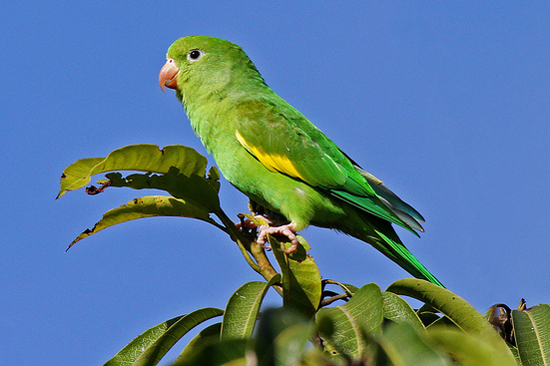
The most widely distributed form, and the one that was imported in the greatest numbers in the early days of mass importation, was the canary wing (Brotogeris versicolorus chiriri). This little bundle of joy is bright green and flashes a bright canary-yellow patch of color on the upperside of its wings. This type has the largest range, including the vast majority of South American countries.

Literally thousands of these were imported from Paraguay, where the indigenous Guarani Indians call them "chi-ri-ri." This name comes from the call that they make as the flocks fly through the trees. In accordance with this, the subspecific scientific name chosen by the Scientist who first described them to the rest of the world is chiriri. Although they were all wild-caught, once they were separated from their "buddies" and had their wings clipped, they quickly became tame and affectionate pets.

During the same time period, small quantities of the canary wing's closest look-alike were also imported. This was the white wing (B. versicolorus) from Eastern Peru and Ecuador. With its wings closed, it shows a yellow patch that is just like the canary wing's. The bird is an overall duller shade of green but flashes a big surprise when it opens its wings: The yellow on the wing is replaced by pure white as the colored wing patch moves toward the tip of the wing. White is a very rare color in New World parrots. This bird was always relatively rare in aviculture but is now beginning to gain a small foothold. This is due to the introduction of new bloodlines into aviculture from a wild flock in South Florida. Like the canary wing, it was also released from imported shipments but in much smaller numbers.

The second type of Brotogeris to be imported in large numbers was the grey cheek (B. pyrrhopterus) from the Pacific coast of western Peru and Ecuador. This bird's overall pastel greens, blues and grays make it look a world apart from its cousins.

Grey cheeks were not only the most divergent in coloration, but were also the first Brotogeris in modern times to be imported exclusively as hand-raised babies. These birds were harvested seasonally from the nests of their wild parents and hand-fed until they were old enough to export. Due to this, the grey cheek is the bird that is responsible for the vast popularity that the entire family enjoys in the pet trade today. Unfortunately, grey cheeks have not proven to be reliable breeders, and since importation has ended, they have become difficult to find.

The next best-known member of the group is the orange chin (B. jugularis). This bird is the family representative throughout Central America. These highly intelligent and gregarious clowns have bright-green body feathers with a bronze-brown patch of color on the sides of their wings. True to their name, they sport a bright-orange patch of feathers under the lower mandible.

Those that were imported came in from Honduras and were all hand-raised. Unfortunately, most importers were only interested in the highly valuable yellow-naped Amazons that were being collected from the same areas. They chose not to take the health risk of bringing in these relatively inexpensive birds with the yellow napes. Due to this, only a few shipments of several hundred birds each were imported during this short time period. Fortunately, several breeding facilities, including my own, are producing them regularly on a yearly basis.

Quite similar in appearance to the orange chin is its Bolivian cousin, the cobalt wing (B. cyanoptera). They do not have the same rich green coloration on the body, but this is more than made up for with the cobalt-blue coloration displayed when they open their wings. Imported in very small numbers during the early 1980s, most of the birds wound up in the hands of bird breeders. Although this bird has a foothold in several breeding facilities, it will be a while before there are sufficient numbers to reroute them from the breeders to the pet trade.

The rarest of the "available" members of this clan is the golden wing (B. chrysopterus) from Surinam, South America. These birds have an unusual deep dark-green body coloration that is different than the green seen on any other New World parrot. They are highlighted by a bright-orange patch of color on their wings when in flight. As with all the other members of the family, they are incredibly entertaining and affectionate pets. Although this bird has proved to be difficult to breed in most aviaries, we at the Institute have been lucky enough to have several pairs that produce regularly every year.

The remaining two members of this group are the plain color (B. tircia) and the tui (B. sanctithomae). The plain color is a bird from Brazil that was never imported. As its name implies, it lacks the flash of color that all the other members of the group have somewhere on their bodies. The tui, on the other hand, was imported many years ago from Colombia. This bird looks like a miniature yellow-fronted Amazon and makes a marvelous pet. It is probably the most highly sought-after bird of the group. Unfortunately, during the time that they were imported, there was very little interest in captive-breeding. Due to this, they have all but disappeared. There are still a few pairs in competent hands, and we are all hoping for the best.

Howard Voren in the founder and director of the Voren Research Institute for Psittacultural Science and has bred several species of Brotogeris. Article originally appeared in the 1996/97 Birds USA. This is copyrighted material, reprinted with the author's permission. This article may not be reprinted without written consent from the author.

Brotogeris: The Masters of Adaptation

by Howard Voren

If any New World parrots could be called the "masters of adaptation," it would be those of the genus Brotogeris. Whenever you travel through Central or South America, the representatives of the parrot family that you are almost guaranteed to experience are those from this unique group. Their high visibility stems from the fact that they enjoy flying in large flocks and soar as a group through any areas that have stands of large trees.

"Not so unusual," you say. Well, it is if the stands of large trees are in parks in large cities. These are the only parrots that seem to pay no attention as to whether the trees in which they play and feed are in the city or in the jungle.

As long as there is still a supply of seeds, fruits, berries or blossoms, they will continue to return to their favorite feeding sites, day after day. The general rule that "if people move in, the parrots move out" has been largely ignored by these little wonders.

Flock Behavior

Although individually they are small enough that they could never attain the description of being noisy. As a group of 100 or 200 they can more than attract your attention with their excited chattering.

I will never forget that during one of my trips to Central America I spent 10 minutes staring incessantly upward into the foliage of a 100-foot-tall ficus tree. I could hear the chatter two blocks away, but I couldn't see them. All of a sudden, like a huge green cloud, they burst out of the canopy all at once and flew off to another large tree a few blocks away. They chattered as rapidly as they flew. They were oblivious to the fact that they were in a major metropolitan area. After all, at the 100-foot level, there was little concern regarding us humans.

Habitat

Brotogeris have found a niche and held on successfully in almost every Central and South American country. A group of escapees have even "colonized" in and around a metropolitan area of South Florida, called Coconut Grove. As well as they get along in the presence of humans, they do as well or better in uninhabited areas. All seven species of this small green parrot are common throughout most of their range.

Brotogeris have also shown their talent for versatility in the fact that they are one of the only members of the parrot family that has adapted to more than one type of nesting habitat. They not only test in tree hollows, as do most all other psittacines, but they will also create their own nests as an alternative when other hollows are not available. The most common place for this alternative nest is an arboreal termitarium (a termite's nest in a tree).

In Central and South America, there are termites that will build nests in trees. These appear as large brown mounds of paper mâché, sitting in the crook of a tree limb. The birds will excavate tunnels and make nesting chambers in the center of the termite mounds. They will lay their eggs in their "custom-built" nesting chambers. The Brotogeris are also the only parrot-type birds I know of that have been rumored to, on rare occasions, have females sharing their nests with one another.

Size, Color And Availability

Brotogeris are all quite similar in body size. Although their length ranges from 6½ to 9 inches, the bulk of the differences are in the length of the tail.

Plain parakeet. The longest species, the plain parakeet (Brotogeris tirica), has the longest tail; it measures one half of the bird's body length. As far as I know, this bird is either quite rare or nonexistent in American aviculture.

Unlike all of its cousins, it lacks a highly colored area on its body. This highly colored area is what has lead to most of the common names given to members of this group. Because of this the bird is called the plain parakeet. It is very common is eastern Brazil where, in true Brotogeris fashion, it not only populates the open country but also the large parks and botanical gardens in the big cities.

Orange-chinned parakeet. The species that has the most northerly range is called the orange-chinned parakeet (B. jugularis). The small bright-orange patch of feathers on its upper mandible is what has given this member its name. Orange chins also have a stronger yellowish tinge to the green feathers of the breast than other members of the group. Their range extends from southern Mexico, south through Central America into the South American countries of Colombia and Venezuela.

Although they have a very long range, the majority of those that were imported into the United States were from Honduras. They were never imported in large quantities. Those that were imported were taken from their nests as babies and hand-fed until independence. Because of this, they made such wonderful pets that most of them never resurfaced into the breeder trade. The few that were set up for breeding are producing well, but their production falls very short of the large demand. They are an old favorite that has now become quite difficult to obtain.

Grey-cheeked parakeet. The one member of this group that was hand-raised in the greatest quantity for export to the U.S. was the grey-cheeked parakeet (B. pyrrhopterus) from Ecuador and Peru. A large area of light gray on the cheeks is set off by a beautiful blue-green coloration on its head.

Literally tens of thousands of these birds were imported from Peru. In fact, during the "heyday" of their importation, they were commonly called Peruvian grey cheeks. It was not uncommon for shipments of up to 1,000 birds to land in Miami, Florida, from Lima, Peru, to be quarantined in USDA-run facilities. As with all legally imported birds, they were quarantined for 30 days before they were released to the pet trade.

Because they were hand-raised before they were exported from Peru, they made excellent pets. At one point in time, they were, by far, the most popular pet bird in America next to the budgie and the cockatiel.

For a few years before their importation was ended, waiting for the Peruvian grey cheek season became a yearly tradition for pet-bird retailers. Unfortunately, this species has failed to maintain itself in captive-breeding programs. As the importation era slips further and further into the past, they are becoming more and more difficult to find.

Canary-winged parakeet. The bird most commonly thought of when one thinks of this group is called the canary-winged parakeet (B. versicolurus chiriri). The scientific name of this subspecies, chiri, comes from the name that the indigenous Amazonians gave to the bird. "Chi-ri-ri, chi ri, chi-ri-ri" is a very accurate rendition of their chattering call as they fly through the jungles. Having a range that involves the majority of South America, they were by far one of the most commonly imported birds into the U.S.

Its outstanding color characteristic is the canary-yellow patch of color that it sports on its wings. This bird carried several different popular names in the U.S. pet trade. Among them were "bee bee" and "pocket parrot."

Although it was imported in the largest numbers, most of these numbers were brought in before there was an interest in captive propagation. In short, when they were available, no one cared to set them up for breeding. Because they were wild-caught rather than taken from the nest and hand-raised, they never developed the reputation for pet quality that the grey cheek and the orange chin maintained. Now that the entire group is more fully appreciated, there is a new demand for them as pets. Until recently, it was very difficult to obtain good specimens for breeding purposes. Almost no one was breeding them, and those who were still around were too old to be used in a breeding program. In a unique turn of events, the birds that are now being used to populate American breeding farms so hand-raised babies can be had for the pet trade are captured from wild flocks that have established themselves in Florida. This is also true of the well-known but relatively rare white-winged parakeet.

White-winged parakeet. Very similar to the canary wing, the white wing subspecies (B. v. versicolurus) differs in having the majority of the large colored area of its wing white instead of yellow. They are duller green in body coloration than chiriri and still show yellow as their patch of wing color when their wings are closed. When they open their wings for flight, however, a large impressive area of white is displayed. This was a bird that was always very rare in American aviculture until recently. There is now an established wild flock of these in South Florida. Thanks to this, American aviculturists are getting a second chance at establishing this unusually colored bird.

Cobalt-winged parakeet. This one member of the family that is the most commonly misidentified is the cobalt-winged parakeet (B. cyanoptera). Although it is named for the extensive area of blue coloration on its wings, it also has the orange "chin" coloration of the orange-chinned parakeet.

Although its range extends from southern Colombia and Venezuela, south to northern Bolivia, those that were imported into the U.S. were from Bolivia. This bird was never imported in large numbers. The greatest percentage of those that came into the U.S. were sold to those who wished to breed them; however, some did go to the pet trade. Those who are lucky enough to have them in their homes as pets are usually under the misconception that they have orange chins, not cobalt wings. One easy method for determining the difference is the coloration on the head. Only cobalt wings will have yellow feathers around the nostrils.

Golden-winged parakeet. The rarest from the standpoint of numbers imported, is the golden-winged parakeet (B. chrysopterus). Although they are commonly from the area of Brazil, in and around the Amazon River, the ones that are here in the U.S. were imported from Surinam.

Their name stems from the bright, golden orange patch of feathers on their wings. This brilliant color is highly visible when they are in flight. Their overall body coloration is a very unusual shade of dark green. This shade of green is never seen on any other Central or South American parrots. At the Voren Research Institute, we have made a concerted effort to establish this uniquely colored bird. We now have 20 pairs that include the offspring of our original group of 15 unrelated birds.

Tui parakeet. By far, the most highly sought after by connoisseurs of the group is the tui parakeet (B. sanctithomae sanctithomae). These delightful, little birds look like miniature yellow-fronted Amazon parrots. They are a beautiful bright green in body coloration and have a large patch of yellow that covers the forehead. The tui is distributed along the entire length of the Amazon River as well as its tributaries. This bird is the favorite childhood pet of the tribal peoples that live along the Amazon. In the late ‘60s and early ‘70s, before there was the requirement of quarantine in the U.S., these birds were imported in fair numbers. Unfortunately, this was a time in history, when there was no interest in breeding Brotogeris in captivity. Shortly after this, the countries that were permitting their export banned all exportation of birds. At present, the bird is almost nonexistent in the U.S.

Master aviculturist Robbie Harris from California has been lucky enough to obtain a few birds and is making a valiant effort to re-establish them in captivity.

The entire family does well on a seed-based diet with plenty of fruits and vegetables. We feed sprouted beans along with a "cockatiel" seed mixture. They also get diced carrots, apple and corn. We dust these items with wheat grass powder (green food supplement) and an all-inclusive vitamin and mineral supplement. This diet has kept them strong, healthy and productive for many years.

Pellets can also be considered if you don't have the time to feed them a varied diet. They are not only very hardy birds, they also have the ability to be quite long-lived for their size. I was personally acquainted with one that lived to the ripe old age of 35 years.

Whether you would like to have them as a lifetime companion or as a breeding investment, sharing your home with members of the Brotogeris family is a rewarding experience.


Reprinted with permission.

Howard Voren in the founder and director of the Voren Research Institute for Psittacultural Science and has bred several species of Brotogeris for the last 10 years. Article originally appeared in the May 1997 issue of Bird Talk. This is copyrighted material, reprinted with the author's permission. This article may not be reprinted without written consent from the author.

August 28, 2010

The Grey-Cheeked Parakeet and Its Family

by Robbie Harris

The ever popular grey-cheeked parakeet is part of a genus of birds called Brotogeris. This group has seven species, with the grey cheek now being the most popular.

More than 30 years ago, the bee-bee parrot (also known as the orange-chinned parakeet) was the member of the Brotogeris genus that most people sought out as a pet. Bee bees were offered for sale in most pet shops, and even today, people over the age of 70 are still calling me looking for bee-bee parrots. This bird was a very popular little pet back in its time. The orange-chinned parakeet also goes by the name of the Tovi parakeet, but the bee bee nickname is the most common name used for this bird.

Many years later, over a decade ago, a new little bird was imported here into the United States. These cute little birds stole the hearts of almost everyone who came into contact with them. The birds would beg for human attention, practically screaming, "Hold me, hug me, love me!" For years, the import stations would sell out quickly--many times in just a couple of days. The name of this charming import was the Grey-cheeked parakeet.

The grey cheek imports were hand-reared babies, and that is the only reason they came into the country so tame. Grey cheeks are far from naturally tame birds. A wild-caught adult bird can be just as nippy and feisty as a wild lovebird imported grey cheeks were very young babies that were hand-reared in Ecuador and Peru. For years, the chicks were hand-fed right here in U.S. quarantine stations by employed hand-feeders. Babies were hand-fed a baby food formula two to three times a day until they were able to eat solid foods on their own.

The general care and breeding of all Brotogeris is the same. All the birds in this family make excellent pets when purchased as very young hand-fed babies. The most commonly available is the grey cheek, followed by the canary wing, the Tovi, the cobalt wing, and the golden wing. Until very recently, these were the only Brotogeris being bred in the United States. Now, the Tui parakeet--the most beautiful to me--is being bred here, too (by me). These birds will not be available as pets for many years; aviculturists must establish pairs of them for future breeding. Establishing breeding pairs first and selling pets second is very important for all uncommon species.

Some of the young and adult Brotogeris will tame with much patience and time, but nothing can compare to a hand-reared baby. These by far make the best pets. Grey cheeks and their relatives are highly intelligent, which has contributed to their popularity as house pets. They are very bold, and even though they are only 7 to 8 inches long with a weight of 50 to 60 grams, they will challenge a parrot three times their size.

Members of the Brotogeris genus often become very attached to their owners. Their chattering voices can become loud at times (this happens more frequently with grey cheeks than with the other species). A single bird kept as a pet, however, is usually not very noisy. Most birds learn to vocalize because their new owners run to pick them up or remove them from their cages at the first sound of a peep, thinking, "How cute, he's calling me." Soon, the bird learns to expect attention when it calls. If the bird is ignored, it just continues to scream louder and longer, hoping someone will hear and come to play with it like they used to do. Remember, birds, like all animals and people, learn by association. Take your pet out to play when it is being quiet, never when it is being noisy. Don't teach your bird to call you, and you could end up with a quieter pet.

When purchasing a young, weaned bird, try to be sure of its age. Once the babies of most Brotogeris are fully feathered and weaned, they resemble their adult parents. If you are a novice with birds, you may find it difficult to determine the true age of your fully feathered pet; many young and older birds look very much the same. Healthy baby Brotogeris are feathered by the time they are 7 weeks of age. The most important thing is to buy your bird from a reliable source, whether it's a breeder or pet shop.


Grey-cheeked Parakeet (Brotogeris pyrrhopterus)

The most common of all Brotogeris, the grey cheek has also been referred to as the pocket parrot, the orange-flanked and the orange-winged parakeet. This brightly colored green bird is paler on its underparts. The gray chin, forehead and cheeks are what give this bird its name. The primary coverts are blue, and the crown is bluish. The grey cheek is the only Brotogeris with a bright-orange patch on its underwing coverts, which sometimes can just be seen as a touch of orange on the shoulder tips. When a grey cheek lifts its wing, the large orange area can clearly be seen.

Very young chicks are easy to identify by their prominent black beaks. The black-colored beak will soon turn to the horn color of an adult, usually by the time the chick reaches 6 months of age. Range: Western Ecuador and northwestern Peru


Canary-winged Parakeet (B. versicolurus chiriri)

This is a bright apple-green-colored bird, lighter colored on its underparts. A large band of bright canary-yellow color appears on the secondary coverts. This, of course, gives this bird its common name. There is a slight tinge of blue to the flight feathers. I often see canary wings offered for sale as domestic babies. Range: Parts of Brazil, Bolivia, Paraguay and Argentina


White-winged Parakeet (B. v. versicolurus)

This bird, the nominate race of its species, differs from the canary wing in many ways, almost so much that it seems hard to believe they are just different subspecies rather than entirely different species. First of all, the white wing's green color is darker and slightly more olive-colored. The white-winged parakeet also has a canary-yellow color on the wing and a large patch of white as well. With this bird's wings folded, the white often does not show. White wings also have less facial feathering around the beak and eye areas.

My son Larry has a domestic white wing for a pet, which I raised. This little bird just adores him and will fly to him when he calls her. Larry plays with her as if she were a toy. She'll lie on her back and stand on her head, and stay in that position until he stands her back upright. She has complete trust in him. She also speaks a few words that were not taught to her, things she heard and picked up. Her favorite word is "Larry," which she yells when he is not around. Range: Parts of Columbia, Ecuador, and Peru


Orange-chinned Parakeet (B. jugularis)

Back in the 1950s, 1960s and even the 1970s, it seemed like anyone who knew anything about a bird knew what a bee-bee parrot (also known as the Tovi parakeet) was; these birds were commonly kept as pets. Many were brought in the country and tamed for pets. They are mainly a bright-green color with lighter shades of green on the underparts. A bright-orange spot can be seen right under the lower mandible, which gives this bird its common name. A large yellow patch can be found on the underwing coverts. There is a blue tinge to the crown, lower back, rump, thighs, and under the tail and flight feathers. Range: Areas of Mexico, Columbia, and Venezuela


Cobalt-winged Parakeet (B. cyanoptera cyanoptera)

Like the orange-chinned parakeet, this bird has an orange chin spot. The forehead is yellow, and the crown is a bluish color. This birds earns its common name from the wing flights and primary coverts, which are a bright cobalt blue. The central tail feathers also have blue, and the underside of the tail is a yellowish green. The overall color is a dark, almost olive, green.

Back in 1983, I received the first U.S. breeding award from the American Federation of Aviculture for breeding the cobalt-winged parakeet. Since then, I've bred large numbers of these beautiful birds, with my third generation now producing young. Range: Part of Venezuela, Columbia, Peru, Ecuador, and Bolivia


Golden-winged Parakeet (B. chrysopterus chrysopterus)

This bird gets its name from the small orange patch on its outer primary wing coverts. A brownish-orange chin spot is present just under the lower mandible. The forehead has a band of dark brown. The main color of this bird is a very dark shade of green. The crown has a blue tinge, as do the cheeks and flights. This is the shortest Brotogeris, at about 6 1/2 to 7 inches, and the stoutest. Range: Areas of Venezuela, Guiana, and Brazil


Tui Parakeet (B. sanctithomae sanctithomae)

This beautiful bright-green bird has a forehead that is yellow, and this yellow extends to the crown. It looks very much like a small 7-inch version of the yellow-crowned Amazon parrot.

Most Brotogeris have a light-colored beak when mature, but the Tui has a very distinctive chestnut-colored beak. The wing flights are a bluish green, brighter blue on the primary coverts. A tinge of blue can be found on the nape, cheeks and undersides of the wing flights.

My young chicks, when just feathered, had dark eyes. As they grew, now more than 6 months of age, their eyes have lightened. When mature, the iris is a glowing golden color. All other Brotogeris have very dark eyes.

Most books state that there is no breeding of this species in captivity. I am breeding these birds and hope to get breeding pairs well established. The adorable chicks are a real challenge to retain for breeding stock; they would have made beautiful pets. I am resisting this temptation, however, to create and establish large numbers of breeding pairs before I ever consider them suitable for the pet market. Range: Areas of Brazil, Colombia, Peru, Ecuador, and Bolivia


Plain Parakeet (B. tirica)

This bird is also known as the all-green parakeet, with this title describing the bird's basic overall color. The plain parakeet lacks the color of other Brotogeris. A bluish tinge is on the hind neck, mantle and underside of the tail. The upper back and wing coverts have a brownish tinge. This bird is not available in the United States. A blue mutation is part of a bird collection in Brazil. Range: Brazil

Brotogeris Diet

A good diet with a variety of foods is very important for these birds to help them maintain excellent health. An improper diet can result in vitamin deficiencies that lower birds' immunities toward diseases.

A well-balanced diet for Brotogeris must contain a variety of fresh fruits and vegetables. Many diets on the pet market today are called complete diets--such as pellet-type diets. As nutritious as these foods might be, Brotogeris need fresh fruits and vegetable in their daily diet. Even if the manufacturers of pelleted diets insist their foods are complete, please offer fruits and vegetables along with the pellets. My birds have done very well on their diet for 20 years now. The following is what I feed my breeding birds as well as my pets.

As a staple food, I offer a seed mix containing a medium-size sunflower seed, safflower seed and a parakeet mix (containing 42-percent canary seed). This food is available to my birds at all times. A good cockatiel seed mix should work just fine for pet grey cheeks or other Brotogeris. Included in their dietary needs is fresh clean water and a mineral block. The mineral block I use is the all-in-one mineral block that contains grit, oyster shell and minerals. Each day, various fruits and vegetables can be offered to your birds. Keep in mind different individual birds prefer different things. The various foods I offer are apples, oranges, peas (fresh or frozen), corn (fresh or frozen), beets, carrots, and greens (spinach, collards or Swiss chard). These can usually be found year round at your grocery store. Additional foods, when in season, are also good to include. These foods include grapes, cherries, plums, pears, bananas, peaches, squash, papaya, and sweet potato (baked and cooled). Other nutritious items include multi-grain wheat bread and breakfast cereals.

Never feed avocado. I know of many birds that have died after eating this fruit. Never use spoiled or overripe produce. To ensure that no insecticides remain, make certain all fruits and vegetables are thoroughly washed before you offer them to your birds. Also purchase a good bird vitamin and lightly dust it on fruits and vegetables at each feeding.


Housing

A simple, safe cage--like one for a budgie or cockatiel--will do just fine for a single pet grey cheek or any other Brotogeris. If using a cockatiel cage, make sure the bars are spaced close enough together so that the bird cannot get its head between them. Many birds injure themselves or worse by getting their heads caught.

Playgrounds with toys and various foods make great play areas for pet grey cheeks. Be sure to supervise your curious pet when it is out of its cage. Grey cheeks are known to get themselves into mischief, so keep a close eye on your pet. If enough toys and treats are kept on their play areas, it helps keep these energetic parrots from wandering off. Many good, healthy treats are available at pet shops, and they should keep your pet happily entertained.

Other interesting treats that seem to amuse my birds are different types of breakfast cereals. Trix now comes in different colors and shapes that seem to generate interest from birds. Other fun cereals come in O's, such as Cheerios.

Breeding

Both sexes of Brotogeris species look alike, so picking pairs can prove difficult. I have all my birds surgically sexed by a competent veterinarian who specializes in birds. Yes, problems can arise from surgical sexing, and a bird can be lost, but this is very rare. I suggest that people do not surgically sex their pets, but have the sex determined by other methods available, such as DNA and feather chromosome analysis.

Sometimes the hens seem more petite in the head and face, and the males may be a bit larger in size. Keep in mind this, too, is not always true when picking out birds; there are many large hens and some very small males.

In the wild, Brotogeris nest in termite mounds found in trees. Aviculturists are unable to come up with these mounds in captivity, so we use the next best thing: wooden nest boxes. I line my Brotogeris nest boxes with a soft type of cork that is used for ceiling and wall covering. This cork comes in 12-inch square tiles. I can easily break these tiles into any size when working with them. I attach the cork lining with a nontoxic glue, such as a white school glue.

At the bottom of the nest box, I place a 2- to 4-inch layer of white pine shavings. The birds will toss out any or all that they do not want inside, so don't worry if your Brotogeris thinks you added too many shavings and send them flying everywhere.

I breed and house only one pair of birds per cage. Quarreling can and does happen when two pairs occupy the same cage. These birds are very capable of killing one another when fighting over territory, so keep this in mind when setting them up for breeding. I live in Southern California where the weather is somewhat mild all year. My birds do well outdoors all through the year. In areas where the weather is good, these birds do just fine outdoors, but they will breed well indoors too. I have seen people breeding grey cheeks right in their living rooms with all the family commotions going on. These grey cheeks seemed to feel right at home and went ahead with their own business. When these birds are ready to breed, there is no stopping them.

I have had very young pairs go right to nest and produce young even before they were a year old. I set up my breeding pairs close together so they can see one another. Grey cheeks remind me of the old saying, "monkey see, monkey do." If one pair starts breeding, many times the other pairs follow and do the very same thing. This type of behavior can send the whole colony to nest, so sometimes it is a good idea to set up individual pairs close together within sight of each other.

The average clutch size is four eggs, but they can lay as many as seven. Usually, however, they will not raise that many on their own. If there are large clutches, I step in and help out, usually by removing some of the older chicks for handfeeding. Many times I have even raised all the chicks from day 1, hatching them in my incubator.

I feel an incubator is a must for anyone who owns breeding birds--even one pair. Many incubators are very inexpensive, costing under $150. One life saved will more than pay for that incubator. I use the incubators put out by Lyon Electric. I run at least six of them at all times during breeding season, hatching eggs as small as a parrotlet's and as large as a big macaw's. When incubating Brotogeris eggs in an incubator, I can candle the eggs in just four days and see the embryo developing (I use the M.D.S. probelite). But when candling eggs under a pair, it could take close to two weeks before I can see if the eggs are alive.

Many Brotogeris do not start incubating their eggs until the last egg has been laid. They may look like they are incubating when they actually are not. Usually an egg is laid every other day, so the complete laying process could take almost two weeks.

Don't discard any eggs until you are absolutely sure the eggs are no good. I have known too many people who broke open eggs that they thought were no good because of the length of time they were in the nest box, only to find a live under-developed chick inside. Incubation is about 26 days from the time the hen starts to sit and actually incubate her eggs. Candle yours eggs about one week after the last egg was laid to be sure of what is happening inside of them.

Most of my Brotogeris, which are set up outdoors all year, start to breed in late winter or early spring. Most usually lay one clutch per year. A few will lay two clutches per year, and on very rare occasions, three times per year. Birds set up indoors may breed anytime they please, even nesting numerous times a year. Remember, each pair is different and has its own individual personality.

Sometimes, owners of grey cheeks become upset when their cuddly pets become aggressive and nippy. If this happens, it is usually an indication of sexual maturity and the birds' desire to breed. Instead of getting rid of their pets like some owners do, these people should buy mates for their birds and supply them with nest boxes.


Hand-Fed Brotogeris Pets

Hand-fed Brotogeris make excellent pets. When raising Brotogeris chicks, it is best to remove them from the next box for hand-rearing between 2 to 3 weeks of age. If the parents raise them all the way to weaning, the chicks may not end up tame, and too much work may be necessary to tame them into sweet, trusting pets.

Handfeeding them at about 3 weeks of age is easy. You can make your own formula or buy a good commercial formula. Many different brands are offered in pet shops. For grey cheeks, as well as any of the other Brotogeris, I would be sure to add some baby food fruits and vegetables. A couple of different varieties are available at grocery stores, and you can add a very small amount to the formula at each feeding. Applesauce, peas, green beans, corn and sweet potato are just a few that may be good choices to add. Add one or two types of fruit or vegetable per feeding.

All hand-reared Brotogeris make excellent pets. Grey cheeks are the most sought after of the Brotogeris because their availability has made them popular. Many people became owners of imported, handfed grey cheeks unexpectedly when they walked into a pet shop to browse. These tame birds just begged for attention, and before the unsuspecting person knew what was happening, he or she became a new bird owner. Soon the word spread that the grey cheek was the only bird to own as a pet. Well, this is just not true. There are lots of really nice birds out there, but the key thing to remember is that they should be hand-fed and tame. Make sure the bird is tame when you get it. You should be able to handle the bird at ease without getting nipped.

There are other Brotogeris besides the grey cheek that are being bred and make just as nice and wonderful pets. Canary-winged and Tovi parakeets are often offered for sale and make great pets when hand-fed. Cobalt-winged parakeets are rarely available, but when they are, they, too, make excellent pets.


Importation Ending

We as birdkeepers and breeders need to be aware of bird-related issues in our world that change quickly. New regulations concerning animals are being drafted all the time, and imported birds that some of us took for granted may soon be unavailable.

A few years ago, new regulations were put into affect that would no longer allow the importation of baby birds unless they were eating on their own, requiring no handfeeding at all during their quarantine stay. All imported birds had to be completely self-sufficient. The day of the real baby grey cheek as a pet may soon end unless they are domestically reared in larger numbers. Most of the grey cheeks imported were still young and tame, because they were hand-reared in their country of origin.

Now there has been an even newer regulation that has just gone into effect pertaining to grey cheeks. This has stopped all imported grey cheeks from entering the United States. Now, anyone wanting a tame grey cheek is totally dependent on grey cheek breeders. The most unfortunate thing about this situation is that there are very few bird breeders keeping and breeding grey cheeks and other Brotogeris. Something must be done quickly to set up pairs for future breeders to enjoy. Right now, there are still large numbers of grey cheeks in the United States. Pairs can still easily be put together. Soon, however, it may be next to impossible to procure these birds.

Look at the very popular bee-bee parrot, a formerly popular member of the Brotogeris group that has practically disappeared. There were large numbers of these birds at one time too. Now it takes some effort to find even one for sale. This is what could easily happen to the grey cheek if people do not start obtaining them and creating true pairs for breeding.

Soon, if not already, the famous grey-cheeked parakeet will be very difficult to find--especially tame sweet babies. Regulations to stop all birds from entering our country may soon be imposed. With all the deforestation, very few birds may be left on earth at all. Domestic breeding of birds is a must!

I can remember telling people that when importation closes, the price of grey cheeks will soar. Well, that time has finally come. The shortage of grey cheeks here may not be felt for some time because of the large numbers that were imported in the past few years. But the number of available baby grey cheeks has now been cut drastically.

Yes, they do take some work and patience to breed successfully, but believe me, they are well worth the effort. These birds should not only be kept as pets but bred as well to assure a future supply. If this does not happen, they may disappear for good.

Article originally appeared in the March 1993 issue of Bird Talk. This is copyrighted material, reprinted with the author's permission. This article may not be reprinted without written consent from the author and Bird Talk magazine.